
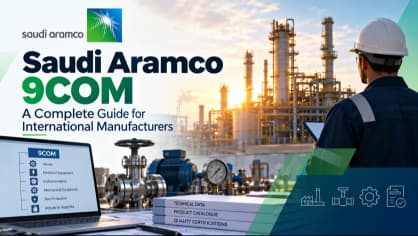
Saudi Aramco 9COM: A Complete Guide for International Manufacturers
Saudi Aramco 9COM: A Complete Guide for International Manufacturers
Saudi Arabia's energy sector presents significant opportunities for international manufacturers, but entering the supply chain requires more than submitting a supplier registration. One of the most misunderstood concepts is Saudi Aramco 9COM.
Many businesses assume that Saudi Aramco 9COM is simply another registration requirement. In reality, it is a product classification framework that helps organise materials and supports supplier qualification activities. Understanding how it works, and how it differs from supplier registration, can help manufacturers prepare more effectively before pursuing opportunities in Saudi Arabia.
Expert guidance by Plus UAE | Updated 2026
What Is Saudi Aramco 9COM?
Saudi Aramco uses 9COM as a commodity classification system to organise products into standard material groups. Rather than identifying an individual product, a 9COM code represents a category of products with similar characteristics.
For example, valves, electrical equipment, instrumentation, industrial fasteners, or fire protection products may each belong to different commodity classifications depending on their application and specifications.
This structured approach enables procurement and technical teams to identify suppliers that manufacture products relevant to specific operational requirements.
Why Was 9COM Created?
Large industrial organisations manage thousands of product types sourced from suppliers worldwide. A standard commodity classification system helps to:
- Organise procurement activities
- Improve supplier categorisation
- Simplify product searches
- Support technical evaluations
- Maintain consistency across procurement projects
Rather than reviewing every supplier manually, procurement teams can identify manufacturers associated with relevant commodity groups.
9COM vs Supplier Registration
Many manufacturers confuse these two concepts. Supplier registration introduces your organisation to the procurement system, while Saudi Aramco 9COM helps define what your company manufactures.
| Aspect | Supplier Registration | 9COM |
|---|---|---|
| Purpose | Registers the company | Classifies products |
| Focus | Company-focused | Product-focused |
| Nature | Administrative onboarding | Technical categorisation |
| Outcome | Creates supplier profile | Supports product identification |
9COM vs 9CAT
These terms are often used together but have different purposes. Understanding this distinction helps manufacturers prepare more accurate product information.
| Aspect | 9COM | 9CAT |
|---|---|---|
| Level | Commodity group | Specific catalogue item |
| Represents | Product family | Individual approved product |
| Used for | Classification | Catalogue management |
Who Should Understand 9COM?
This topic is particularly relevant for the following types of manufacturers and suppliers. See all the sectors we support on our Industries page.
Equipment Manufacturers
- Original Equipment Manufacturers (OEMs)
- Industrial Equipment Manufacturers
- Mechanical Equipment Suppliers
Flow and Electrical
- Valve and Pump Manufacturers
- Electrical Equipment Suppliers
- Fire Protection Equipment Manufacturers
Technology and Controls
- Instrumentation Companies
- Automation Providers
- Industrial Technology Companies
Does Every Manufacturer Need the Same 9COM?
No. The appropriate Saudi Aramco 9COM classification depends on the products your organisation manufactures.
A company producing industrial valves will typically require different classifications from one supplying electrical switchgear, instrumentation systems, or automation equipment.
Manufacturers should ensure that their product information accurately reflects the categories relevant to their offerings.
Common Mistakes Manufacturers Make
Many international manufacturers delay their readiness because of avoidable issues. Addressing these early can improve preparation for future supplier evaluations.
Selecting Incorrect Commodity Classifications
Choosing categories that do not match the products you actually manufacture makes your capabilities harder to understand.
Submitting Outdated Product Catalogues
Old catalogues can misrepresent your current product range.
Providing Incomplete Technical Specifications
Missing specification details slow down technical review.
Missing Quality Documentation
Quality records and certifications should be ready before you start.
Inconsistent Product Descriptions
Different wording across documents creates confusion about what you offer.
Poor Document Organisation
Disorganised files make it difficult to respond quickly to requests.
Building a Strong Technical Portfolio
Before pursuing supplier opportunities, manufacturers should organise the following:
- Company profile
- Product catalogues
- Technical datasheets
- Material specifications
- Product certifications
- Manufacturing capability statements
- Quality management documentation
- Inspection and testing procedures
- Previous project references
A well-structured technical portfolio demonstrates professionalism and helps communicate manufacturing capability.
Best Practices Before Exploring Supplier Opportunities
Successful manufacturers often follow these practices:
- Maintain updated technical documentation
- Review product classifications regularly
- Keep quality certifications current
- Improve document control procedures
- Assign dedicated technical contacts
- Review engineering information periodically
Preparation reduces delays and improves organisational readiness.
Frequently Asked Questions
Common questions from international manufacturers about Saudi Aramco 9COM.
1. Is 9COM the same as supplier registration?
No. Supplier registration creates your company profile, while 9COM is used to classify products into commodity groups.
2. Does obtaining a 9COM guarantee business opportunities?
No. Supplier registration, product classification, or qualification does not guarantee tender invitations or contract awards. Opportunities depend on procurement requirements and evaluation processes.
3. Can international manufacturers pursue opportunities?
Yes. International manufacturers may participate in supplier onboarding processes where applicable and subject to procurement requirements.
4. Why is product classification important?
Accurate product classification helps procurement teams understand a manufacturer's capabilities and supports efficient supplier evaluation.
How Plus UAE Supports International Manufacturers
Expanding into Saudi Arabia requires more than completing forms. Manufacturers benefit from careful preparation, organised documentation, and a clear understanding of procurement expectations.
Plus UAE supports international businesses with:
- Saudi market entry strategy
- Supplier registration guidance
- Documentation preparation
- Commercial representation
- Business setup support
- Government liaison services
- GCC expansion planning (see our advisory team)
Related Reading
Continue exploring UAE and GCC market entry on the Plus UAE blog.
Conclusion
Understanding Saudi Aramco 9COM is an important step for international manufacturers planning to enter Saudi Arabia's energy sector. While supplier registration introduces your company to the procurement ecosystem, accurate product classification, strong technical documentation, and organised internal processes help demonstrate manufacturing capability and readiness.
Related Insights & Market Guides
National Guard Permit in Abu Dhabi
Explore key advisory details, statutory procedures, and strategic insights for this topic in the UAE.
ADNOC Agent in UAE
Explore key advisory details, statutory procedures, and strategic insights for this topic in the UAE.
ADNOC Prequalification
Explore key advisory details, statutory procedures, and strategic insights for this topic in the UAE.
Contact Plus UAE
Get Expert Market Entry Advice Today