
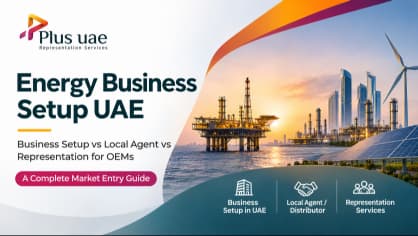
Energy Business Setup in UAE: The Complete Market Entry Guide for International OEMs
Energy Business Setup UAE: The Complete Market Entry Guide for International OEMs
For international Original Equipment Manufacturers (OEMs), engineering companies, technology providers, and specialist service firms, the United Arab Emirates has become one of the world's most attractive destinations for energy-sector expansion.
Driven by continuous investments in oil and gas, LNG, power generation, hydrogen, renewable energy, carbon capture, petrochemicals, and industrial infrastructure, the UAE offers long-term opportunities for companies that can deliver innovation, quality, and technical expertise.
However, entering this market successfully requires more than an excellent product or proven engineering capability. One of the most important strategic decisions is choosing the right market-entry model.
- Should your company complete an Energy Business Setup UAE process and establish a legal entity immediately?
- Should you begin with a local representative?
- Would a distributor or commercial agent be a better fit?
The answer depends on your objectives, target customers, budget, and long-term strategy. This guide explains every major option and helps international companies determine the most effective path into the UAE energy market.
Why the UAE Energy Market Continues to Attract Global Companies
The UAE has transformed itself into one of the world's leading energy hubs. While the country remains a major oil and gas producer, it is also investing heavily in:
- Renewable energy
- Nuclear power
- Hydrogen projects
- Petrochemical expansion
- Offshore developments
- Industrial manufacturing
- Smart utilities
- Digital transformation
- Carbon reduction technologies
These investments create opportunities for international manufacturers supplying:
- Process equipment
- Industrial automation
- Fire & Gas Systems
- Electrical equipment
- Instrumentation
- Marine engineering solutions
- Inspection technologies
- Pumps and valves
- Rotating equipment
- Mechanical systems
- Digital industrial software
For many overseas companies, the UAE also serves as a gateway to Saudi Arabia, Qatar, Kuwait, Oman, Bahrain, and wider Middle East and African markets.
Who Buys Energy Equipment in the UAE?
Understanding the procurement ecosystem is essential before planning an Energy Business Setup UAE strategy. Major buyers include:
- ADNOC Group
- TAQA
- ENEC
- EWEC
- EPC Contractors
- Offshore Operators
- Refineries
- Petrochemical Companies
- Utility Providers
- Industrial Manufacturers
Most of these organizations work through structured supplier qualification processes rather than direct purchasing, making preparation and compliance just as important as product quality. Supplier registration and pre-qualification are often prerequisites for participating in tenders.
Why Many Overseas Companies Struggle
Many international businesses assume that opening an office is enough to secure projects. In reality, success depends on much more than company incorporation. Common challenges include:
- Understanding procurement procedures
- Selecting the correct licensing model
- Meeting supplier qualification requirements
- Building relationships with EPC contractors
- Preparing technical documentation
- Navigating local regulations
- Developing an effective local presence
This is why choosing the correct business setup in UAE strategy is one of the most important commercial decisions an OEM can make.
Three Main Routes into the UAE Energy Market
International companies generally choose one of three approaches. Each offers different advantages depending on your growth plans.
Energy Business Setup UAE
Establish a UAE legal entity and operate directly.
Local Distributor or Commercial Agent
Partner with an established local company to market and sell products.
Representation Services
Develop the market, pursue registrations, build relationships, and validate opportunities before establishing a permanent company.
Why the Right Entry Model Matters
Choosing the wrong model can lead to:
- Higher operating costs
- Delayed market entry
- Missed tender opportunities
- Limited customer engagement
- Inefficient resource allocation
By selecting the most appropriate strategy from the outset, companies can reduce risk while improving their chances of winning business in the UAE's competitive energy sector.
Not Sure Which Entry Model Fits Your Business?
Speak to our team about the best route into the UAE energy market for your company, products, and budget.
Energy Business Setup UAE: Building a Long-Term Presence
For companies committed to long-term growth, Energy Business Setup UAE provides the highest level of market access and operational control. Rather than depending entirely on third parties, businesses establish their own legal presence, engage directly with customers, and build sustainable operations within the UAE.
What Is an Energy Business Setup in UAE?
An energy business setup involves establishing a legally registered company that is licensed to carry out approved commercial or industrial activities related to the energy sector. Depending on the business model, a company may undertake activities such as:
- Engineering consultancy
- Industrial equipment supply
- Technical services
- Project management
- Maintenance support
- Automation services
- Inspection services
- Procurement support
- Regional sales operations
The appropriate structure depends on the company's activities, customers, and long-term objectives. A valid trade license is the foundation of any legal presence.
Advantages of Energy Business Setup UAE
Direct Access to Customers
A local entity enables companies to engage directly with energy operators, EPC contractors, consultants, procurement teams, and government organizations. This improves communication and supports stronger commercial relationships.
Greater Market Credibility
A professionally established business setup in UAE demonstrates long-term commitment. For many buyers, a local presence enhances confidence in technical support, project execution, warranty services, after-sales maintenance, and long-term collaboration.
Improved Project Delivery
Large industrial projects often require site visits, engineering meetings, equipment inspections, factory acceptance coordination, technical workshops, and commissioning support. A UAE presence enables faster responses to customer requirements.
Better Positioning for Supplier Registration
Many international manufacturers eventually pursue supplier qualification with organizations such as ADNOC. Registration and pre-qualification involve submitting company, technical, quality, and compliance information before companies can participate in sourcing opportunities. Registration itself is centralized and does not carry a service fee, although eligibility requirements vary depending on the supplier's structure and activities.
Regional Expansion Platform
The UAE can serve as a regional headquarters. From here, many companies coordinate projects across Saudi Arabia, Qatar, Kuwait, Oman, Bahrain, Iraq, Egypt, and North Africa.
Is Immediate Business Setup Always the Right Choice?
Not necessarily. Many international OEMs enter the market before creating a permanent legal entity. They first:
Identify Target Customers
Define who buys your products and services in the UAE energy sector.
Validate Market Demand
Confirm that there is real demand before committing capital.
Develop EPC Contractor Relationships
Build relationships with the contractors that influence equipment selection.
Explore Supplier Registration Requirements
Understand what major buyers require from new suppliers.
Assess Opportunities and Build a Pipeline
Assess project opportunities and build a commercial pipeline.
Once recurring opportunities emerge or customers require a UAE legal entity, companies can transition from market development to a full Energy Business Setup UAE. This phased approach is increasingly common for international engineering and manufacturing companies targeting the UAE energy sector.
Local Distributor vs Commercial Agent: Which Model Is Right for Your Business?
For many international OEMs, establishing a full legal entity in the UAE may not be the first step. Partnering with a local distributor or commercial agent can provide faster access to customers while reducing the initial investment. This approach is particularly attractive for companies that want to validate market demand before committing to a permanent Energy Business Setup UAE.
However, distributors and commercial agents serve different purposes, and understanding the distinction is essential when planning your UAE market entry strategy.
What Is a Local Distributor?
A distributor purchases, stocks, promotes, and resells your products within the UAE market. Depending on the agreement, distributors may also provide:
- Local inventory management
- Technical sales
- Customer support
- Logistics
- Installation coordination
- Warranty assistance
- Spare parts management
Many industrial equipment manufacturers use distributors when entering new markets because they already possess customer relationships and local market knowledge.
Advantages of Working with a Distributor
Faster Market Entry
Instead of spending months establishing operations, a distributor allows products to reach customers quickly, significantly reducing the time required to begin commercial activities.
Existing Customer Relationships
Established distributors often have long-standing relationships with EPC contractors, oil & gas companies, utility providers, marine operators, industrial manufacturers, and government organizations. These relationships can open doors that may otherwise take years to develop.
Lower Initial Investment
Compared with completing an immediate business setup in UAE, working with a distributor generally requires less capital. Companies can avoid many operational expenses associated with a permanent office during the early stages.
Local Sales Expertise
Distributors understand procurement practices, local regulations, customer expectations, tender requirements, pricing structures, and the competitive landscape, helping international OEMs adapt more quickly.
Challenges of Using a Distributor
Despite these advantages, distributors are not always the ideal solution. Potential limitations include:
- Reduced control over sales strategy
- Limited visibility into customer relationships
- Dependence on distributor performance
- Potential conflicts if multiple product lines compete for attention
- Reduced influence over branding and marketing
For companies with ambitious long-term growth plans, these limitations may become significant over time.
What Is a Commercial Agent?
A commercial agent differs from a distributor. Instead of purchasing products for resale, the agent promotes the manufacturer's products and helps generate business opportunities while the manufacturer remains the supplier. Agents typically focus on:
- Business development
- Customer introductions
- Opportunity identification
- Tender monitoring
- Relationship management
- Commercial negotiations
This model is commonly used when manufacturers wish to retain greater control over pricing and customer engagement.
Advantages of a Commercial Agent
A commercial agent can provide:
- Strong local market knowledge
- Access to decision-makers
- Support during negotiations
- Market intelligence
- Business development assistance
- Reduced operational complexity
For specialised engineering products, this model often enables closer collaboration between the OEM and the end customer.
Distributor vs Commercial Agent
| Distributor | Commercial Agent |
| Purchases and resells products | Promotes products without purchasing inventory |
| Manages stock | No inventory management |
| Generates revenue through resale | Earns commission |
| Controls local sales operations | Focuses on relationship development |
| Suitable for standard products | Suitable for technical and engineered solutions |
When Should OEMs Choose a Distributor?
- Products require local inventory.
- Customers expect rapid delivery.
- After-sales support is straightforward.
- The company is entering the UAE for the first time.
- Budget constraints make immediate Energy Business Setup UAE impractical.
When Should OEMs Choose a Commercial Agent?
- Products are highly engineered.
- Technical discussions are extensive.
- Direct customer relationships are important.
- Projects involve long sales cycles.
- The manufacturer prefers to control pricing and commercial negotiations.
Representation Services: A Flexible Market Entry Strategy
Representation services have become increasingly popular among international OEMs seeking to enter the UAE energy market without immediately establishing a permanent legal entity. Unlike distributors or commercial agents, representation services focus on developing business opportunities, supporting market access, and building long-term relationships while allowing the OEM to retain strategic control.
For many companies, this approach serves as an effective bridge before completing a full Energy Business Setup UAE.
What Are Representation Services?
Representation services provide local business development support without requiring the manufacturer to establish its own office immediately. A professional representation partner typically assists with:
- Market research
- Customer engagement
- Lead generation
- Technical meetings
- Opportunity identification
- Supplier registration support
- Tender monitoring
- Partner introductions
- Commercial coordination
- Market intelligence
Rather than simply selling products, representation services help companies establish a long-term presence in the market.
Benefits of Representation Services
Lower Financial Risk
Companies can begin developing the UAE market without the larger investment associated with immediate incorporation. This enables management to evaluate commercial opportunities before deciding whether a permanent business setup in UAE is justified.
Faster Access to Decision Makers
Experienced representation partners often maintain relationships across EPC contractors, energy operators, engineering consultants, procurement teams, government organizations, and industrial investors, which can significantly shorten the time required to establish a presence.
Market Validation
Before investing in offices, employees, and infrastructure, many OEMs prefer to validate market demand, customer interest, competitive positioning, pricing expectations, project pipeline, and procurement cycles.
Support for Supplier Registration
Professional representation companies frequently assist manufacturers in preparing documentation for supplier registration and qualification processes.
Support may include:
- Document preparation
- Company profile development
- Technical capability documentation
- Quality management information
- Compliance documentation
- Coordination throughout registration procedures
Comparison: Which Market Entry Strategy Is Best?
| Factor | Energy Business Setup UAE | Distributor | Representation Services |
| Initial Investment | High | Low | Low to Medium |
| Market Control | Excellent | Limited | High |
| Speed of Entry | Moderate | Fast | Fast |
| Customer Relationships | Direct | Indirect | Direct |
| Brand Visibility | High | Shared | High |
| Long-Term Growth | Excellent | Moderate | Excellent |
| Operational Flexibility | High | Moderate | High |
| Best For | Established OEMs | Product suppliers | Companies validating the market |
Which Option Should You Choose?
There is no universal solution. The most effective strategy depends on factors such as:
- Business objectives
- Investment capacity
- Target customers
- Product complexity
- Long-term growth plans
- Internal resources
Many successful international manufacturers begin with representation services, transition to direct customer engagement, and later complete an Energy Business Setup UAE once sustainable demand has been established.
Supplier Registration, ICV & Building a Successful Market Entry Strategy
Establishing an Energy Business Setup UAE is only the beginning of your expansion journey. To secure opportunities with major energy companies, businesses must also understand supplier qualification, procurement expectations, and local compliance requirements. Preparing these elements early helps international OEMs reduce delays and improve their competitiveness in the UAE energy sector.
Supplier Registration
Most major energy companies maintain structured supplier registration systems to evaluate potential vendors before they participate in sourcing activities. Supplier registration generally involves:
- Company information
- Product and service categories
- Quality certifications
- Financial details
- Technical capabilities
- Compliance documentation
Completing registration correctly improves visibility and prepares suppliers for future procurement opportunities. Our ADNOC registration support helps manufacturers prepare and submit complete applications.
Supplier Pre-Qualification
Registration alone is not enough. Many energy companies require suppliers to complete a pre-qualification process that assesses:
- Engineering capability
- Manufacturing experience
- Project references
- HSE performance
- Quality management systems
- Technical resources
- Operational capacity
Preparing these documents in advance helps avoid delays when new projects become available.
Developing an ICV Strategy
For companies planning long-term growth, developing an In-Country Value (ICV) strategy can strengthen their position during commercial evaluations. Areas that contribute to ICV include:
- Local procurement
- UAE employment
- Investment in local operations
- Training initiatives
- Manufacturing capability
- Economic contribution
While every business has different objectives, considering ICV as part of an Energy Business Setup UAE strategy can support future business development.
Build Relationships Before Opportunities Arise
Successful companies rarely wait for tenders before entering the market. Instead, they invest time in:
- Meeting EPC contractors
- Introducing products to consultants
- Participating in industry exhibitions
- Building procurement relationships
- Conducting technical presentations
- Understanding customer requirements
Long-term relationships often play an important role in successful market expansion. You can also follow Plus UAE Group's company page for updates on UAE market entry and supplier registration.
Common Mistakes to Avoid
International OEMs often encounter challenges by:
- Selecting the wrong market-entry model
- Delaying supplier registration
- Ignoring local procurement practices
- Underestimating compliance requirements
- Entering the market without a long-term strategy
- Focusing only on sales instead of customer support
Avoiding these common mistakes helps businesses establish a stronger foundation for sustainable growth.
Frequently Asked Questions
Is an Energy Business Setup UAE necessary for every company?
No. The most suitable approach depends on your commercial objectives, investment plans, and target customers. Some companies begin with representation services before establishing a permanent presence.
What industries benefit from an Energy Business Setup UAE?
Businesses serving the following sectors can all benefit from a structured market-entry strategy:
- Oil & Gas
- Petrochemicals
- Utilities
- Renewable Energy
- Offshore Projects
- Marine Engineering
- Industrial Automation
- Electrical Engineering
- Fire & Safety
- Industrial Manufacturing
What is supplier pre-qualification?
Supplier pre-qualification is an evaluation process that assesses whether a company has the technical capability, quality systems, experience, and resources required to supply products or services for specific projects.
Is supplier registration enough to win contracts?
No. Supplier registration is only the first step. Companies also need technical capability, competitive solutions, strong customer relationships, and successful participation in procurement processes.
What should international OEMs prepare before entering the UAE?
A successful market-entry plan should include:
- Company profile
- Technical documentation
- Product catalogues
- Project references
- Quality certifications
- Market-entry strategy
- Customer engagement plan
Why Choose Plus UAE?
Entering the UAE energy market requires more than establishing a company. It demands local market knowledge, regulatory understanding, supplier readiness, and a clear commercial strategy.
Plus UAE supports international manufacturers, engineering companies, and OEMs with tailored solutions, including:
- Energy Business Setup UAE
- Business Setup in UAE
- UAE Representation Services
- ADNOC Registration Support
- TAQA Registration Support
- Market Entry Strategy
- Corporate PRO Services
- Government Liaison
- Business Expansion Consulting
Our objective is to help international businesses establish a strong foundation for sustainable growth within the UAE energy sector.
Conclusion
The UAE continues to offer significant opportunities for international energy companies. Choosing the right market-entry strategy, whether through an Energy Business Setup UAE, representation services, or strategic partnerships, can simplify expansion and support long-term business growth. With careful planning and the right local support, companies can position themselves for success in one of the region's most dynamic energy markets.
Ready to Start Your Energy Business Setup UAE?
Whether you need a full legal entity, representation services, or supplier registration support, Plus UAE can help you choose the right route and move forward with confidence. Contact our team today to discuss your UAE market entry plan.
Related Insights & Market Guides
ICV Certificate for ADNOC: Cost, Timeline & Certification Guide
Learn how to get an ICV Certificate for ADNOC. Explore eligibility, costs, timelines, required documents, certification, and support from Plus UAE.
TAQA Commercial Directory Registration Guide for ADDC, AADC & TRANSCO Suppliers
Register with the TAQA Commercial Directory for ADDC, AADC, and TRANSCO. Learn eligibility, required documents, registration steps, and supplier guidance.
National Guard Permit in Abu Dhabi
Explore key advisory details, statutory procedures, and strategic insights for this topic in the UAE.
Contact Plus UAE
Get Expert Market Entry Advice Today